
Walking at the forefront - our thoughts on CWIS3

10,000 new crossings and 5,000 safer routes to school are key themes in the UK Government’s third Cycling and Walking Investment Strategy (CWIS3). But will the suite of measures outlined across the next five years help us meet the ambitious targets the Strategy poses? Zak Viney breaks it down.
The third Cycling and Walking Investment Strategy (CWIS3) sets out the UK Government’s vision, objectives and targets for active travel in England until 2035. CWIS3 aims to to elevate measures to increase walking, wheeling and cycling behaviours and give active travel equal footing to roads and rail strategies. It looks to compliment the Department for Transport’s (DfT) other 2026 strategies, Better Connected and the UK Road Safety Strategy - integrating active journeys within the wider transport system and and connect this work across Government departments, promising a joined-up approach with goals linked to health, economy, environment and planning.
What will CWIS3 achieve?
- £4.5 billion funding across 2025 to 2030 with a focus on connecting schools to homes and high streets
- 2.2 billion more short walking stages to meet a target of 55% of short journeys walked, wheeled or cycled in towns and cities
- 5,000 new walking and cycling routes and 10,000 new safer crossings to meet the target of 60% of 5–16-year-olds walking or cycling to school by 2035
Living Streets' 2024 General Election campaign called for ambitions targets in CWIS3, with specifically a 60% walk to school target. We welcome the aspiration of CWIS3, with targets and plans that could be a game changer for walking and wheeling in England, but how do we get there?
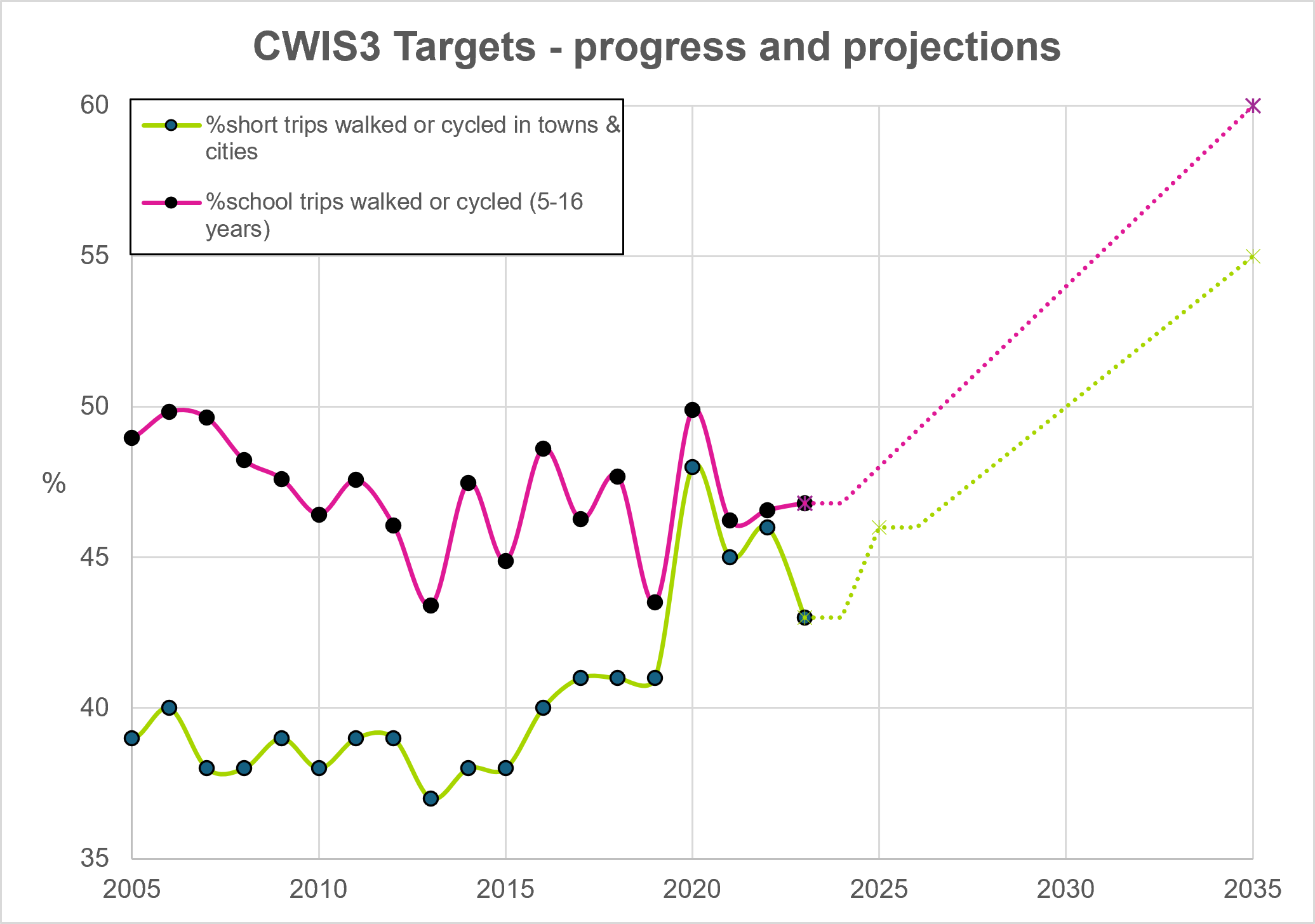
Record funding will need to lead to record delivery for CWIS3 to achieve its goals on short trips and school trips made by active modes. Data source: National Travel Survey 2024, Department for Transport
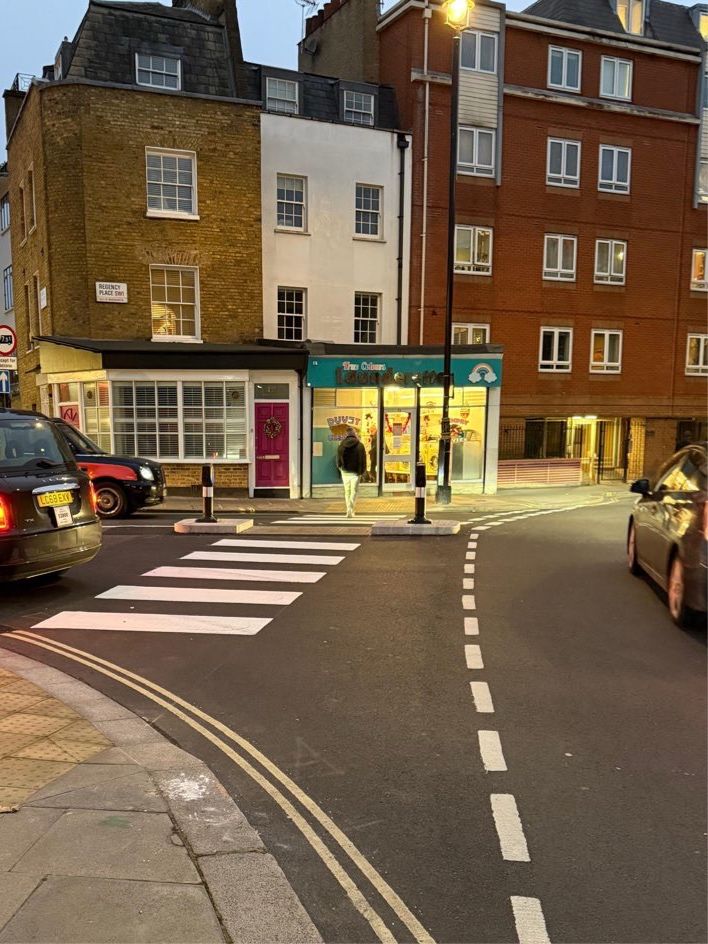
A side road zebra crossing in Westminster, London. Source: Adam Tranter
Walking at its core
We’re delighted to see record funding within CWIS3. The £4.5 billion package makes safer crossings and routes to school key throughout, with clear, accessible pavements an integral theme to the strategy. CWIS3 follows previous Government announcements to tackle pavement parking, pledging to regulate in 2026 to make ‘unnecessary obstruction of the pavement’ a civilly enforceable offence, and rolling out new powers for local leaders to make prohibitions of pavement parking as soon as possible. Other wins for pedestrians here are focuses to address problems of shared cycle schemes blocking pavements and ensure that electric vehicle pavement channels enable normal pavement access and not obstruction.
An update to Traffic Signs & Regulations by 2028 will clarify how traffic signs and road markings, like side road zebras, will be used. Living Streets recognises the opportunities of simpler crossings like side road zebras, strengthening pedestrian priority at junctions and enabling walking and wheeling.
No doubt, CWIS3 has ambitious targets. 60% walked or cycled to school by 2035 equates to over 80,000 new pupils taking active journeys to school every year. Living Streets’ ‘WOW – walk to school challenge’ programme, funded by the UK Government, reduces car kilometres and WOW schools see walked journeys to school increase by an average of 18%. The strategy is also the first CWIS to formalise a target to improve perceptions of safety when walking, wheeling and cycling – something we know are considerable barrier to people making active journeys.
CWIS3 recognises the multi-faceted benefits of travelling actively, and pledges to take a cross-departmental approach, uniting health, environment, economy and planning goals with active journeys. Within this, the most notable commitment is arguably the proposed update to the Manual for Streets, working with Ministry for Housing, Communities and Local Government (MHCLG) to embed this within planning policy.
Can this be delivered?
Money, money, money
In CWIS3’s consultation, the unlikelihood of the government hitting the previous strategy's (CWIS2) targets led Living Streets to recommend a longer term strategy for CWIS3, spanning to 2050.
Such targets being:
- Percentage of short journeys walked or cycled in towns and cities: 2024 actual: 43%; 2025 CWIS2 target: 46%
- Walking stages per person per year: 2024 actual: 339; 2025 CWIS2 target: 365
- Percentage of children usually walking to school (5-10 years): 2024 actual: 51%; 2025 CWIS2 target: 55%
Will CWIS3 rectify this? Record funding of £4.5 billion is a forward step, yet a September 2022 Transport Committee testimony from Active Travel England revealed that £9-18 billion was the funding required to hit their original goal to make 50% of short journeys walked or cycled by 2030. Whilst funding growth is heading in the right direction, time will tell if it is enough to satisfy the strategy's ambitions.
Devolution
This ambition will be delivered via the UK Government strengthening their agenda to English Devolution. Funding and local transport decision making will be issued to Mayoral Strategic Authorities and Local Transport authorities. Local leaders will now decide on whether or not to spend their funds on walking, wheeling and cycling. We encourage Strategic Transport Authorities to utilise these funds to deliver on their commitment to a National Active Travel Network, a pledge from twelve England Combined Authority Mayors to develop an initial 3,500 miles of safer routes to schools, shops and high streets, workplaces and transport hubs.
Whilst a devolved approach provides flexibility to local leaders, Living Streets has raised concerns of consistency and fairness over devolved approaches of the UK Government to transport policy measures, such as pavement parking. Without suitable local authority accountability mechanisms issued by the UK Government, it is likely progress across regions will not be equal across CWIS3’s goals. This concern deepens where dedicated active travel funding from the DfT has not increased in real terms from CWIS2 across to CWIS3.
CWIS3 aims to enable more people, particularly the least active, to benefit from physical activity through active travel. Living Streets encourages this, and there is a big job to do!
Across 2013 to 2024, walking stages for 0–16-years and 17–20-years decreased by 13% and 9%, respectively. In the same time, walking stages taken by ethnic minorities decreased by 12% and by 13% for people in lowest income quintile. By contrast, white people are walking 18% more stages and wealthier people are walking more - with walking stages for those in the highest income quintile increasing 23% between 2013 to 2024.
The investment made under CWIS3 must engage those across all walks of life and address a widening inequality gap in walking and wheeling. Community engagement, prioritising those most left out, or left behind should be core to CWIS3's implementation - with schemes delivered equitably by Strategic Transport Authorities and not dictated by the loudest voices.

About the author
Zak Viney
Campaigns & Public Affairs Coordinator, Living Streets
[email protected]