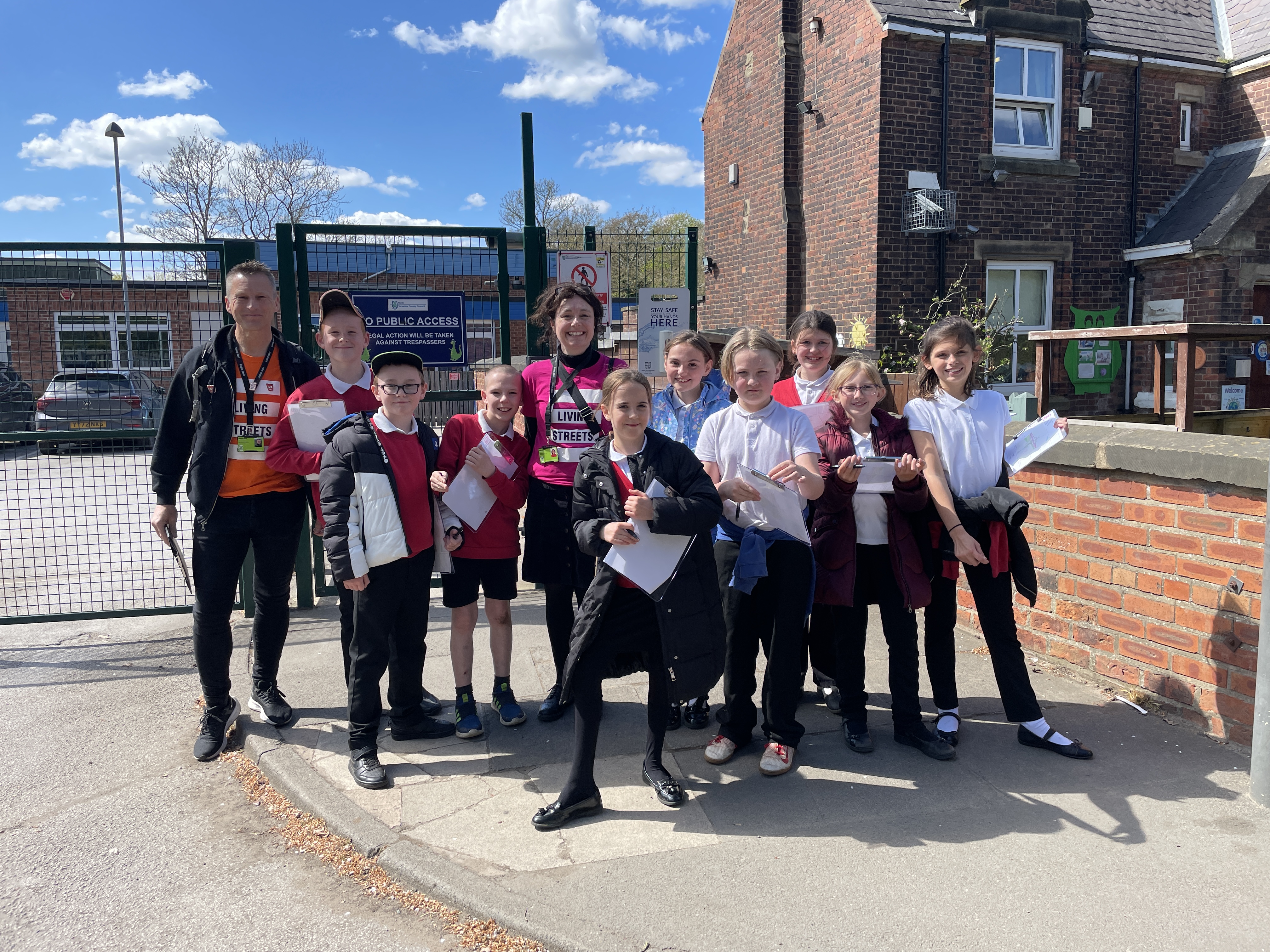
School Route Audits
A School Route Audit is the first step in identifying what simple changes could be made to help more families swap the school run for a school walk.
School Route Audits bring people together to assess their local school streets and ways they can be improved. Our 20+ years’ experience of harnessing residents’ knowledge coupled with our expertise in all things walking and wheeling ensures real life experience of using local streets is captured in situ and allows for people don’t usually take part in consultations to be involved. Our tailored recommendations by our technical experts inform improvements and ensure streets really work for the people who use them every day.
Why School Route Audits are needed and how they are used
Concerns over road safety, personal safety, congestion and parking put families off walking to school. On a School Route Audit, a group of pupils, parents/carers and school staff join Living Streets to inspect their local streets and identify issues that affect them - allowing people who use the streets every day to have their say on what could be done to improve them.
Our technical experts then provide robust recommendations on improvements that could be carried out to support walking and wheeling journeys.
Our audits are widely used by professionals working across public health, sustainable transport and travel planning, road safety, highways and climate action as a key input to a range of processes. The purpose and role of audits can be split into two broad types:
Strategic – such as, supporting Local Walking and Cycling Infrastructure Plans (LCWIPs), public health and decarbonisation strategies, school travel planning and wider community/school engagement.
Planning and delivery – generating scheme ideas, providing evidence for business cases and funding bids, and supporting consultation and delivery of interventions such as 'School Streets', crossings, parking controls and traffic calming.
What School Route Audits do
- Tackle school gate issues, such as congestion, safety and parking problems, providing locally grounded evidence and tailored responses; an important tool for local authorities in engaging schools and communities and demonstrating a proactive response.
- Build evidence for funding bids and business cases providing credible and independent data to justify improvements to walking and wheeling infrastructure, ‘School Streets’ and Park and Stride.
- Support community engagement with an independent voice, strengthening engagement and legitimacy.
- Support scheme development and prioritisation by informing LCWIP development, capital programmes, strategic planning and travel planning (e.g. Modeshift STARS).
- Provide clear and accessible reporting of issues and impacts with photo and map based insights, enabling sharing with a wide range of stakeholders. Our mapping and reporting can be imported into your own GIS systems and complements other schemes, such as Modeshift Active Travel Inspectors (ATIs) and Healthy Streets.
- Align with wider health, climate and physical activity agendas, supporting public health goals, climate action plans, women and girls’ safety, active travel strategies and reducing car dependency.