
Delivery robots taking over UK pavements
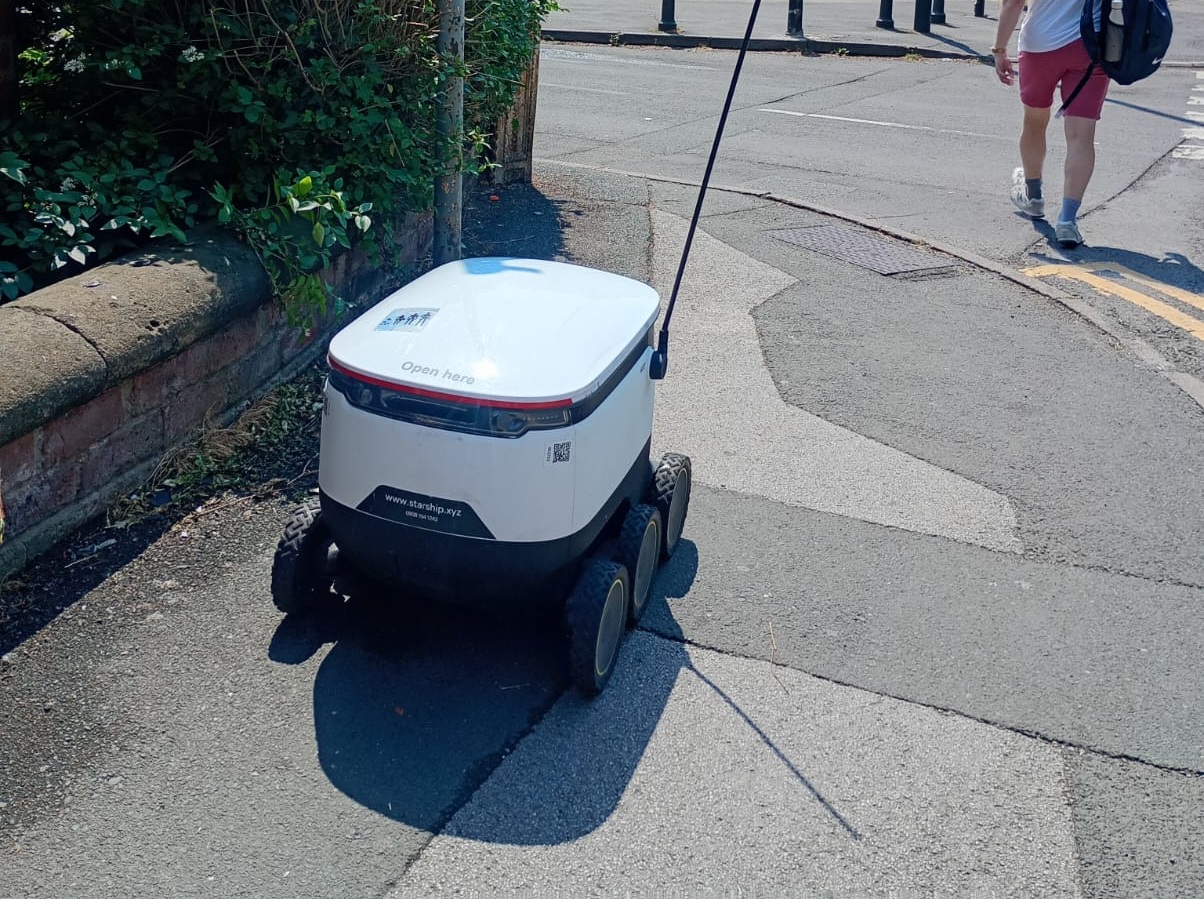
Delivery robots are now operating on pavements across the UK, causing chaos for pedestrians, despite having no clear laws allowing their use.
Pavement Overload, a new campaign from Living Streets, the UK charity for everyday walking, has revealed that delivery robots are now operating on public pavements in Sheffield, Leeds, Reading, Cambridge, Bristol and beyond. These devices operate without any explicit laws governing their use – and in some cases, without consent from the local authority, according to the charity.
An open letter to the Secretary of State for Transport, Rt Hon Heidi Alexander MP (26 June 2026) has called for clarification on the legality of delivery robots and urging national regulations.
Delivery robots have already been banned from cities in the US and Canada, following reports of robots injuring pedestrians, clogging pavements and crashing into pets. The devices can reach 4mph, the same speed as a mobility scooter, and have been known to operate erratically.
Catherine Woodhead, Chief Executive, Living Streets said:
“At Living Streets, we believe that pavements are for people, and the operation of robots puts the safety of pedestrians at risk – particularly for those with mobility issues.
“Our pavements are already lousy with dangerous obstacles, from pavement parking to wheelie bins, preventing many disabled people from leaving their homes.
“It’s also deeply concerning that delivery robots are allowed to operate on pavements with no authority – something that would be unthinkable for a vehicle on our roads. Living Streets is calling on the government not to legalise delivery robots – and to put a stop to the pavement overload.”
Navi Sunnia, Senior Engagement Officer at Transport for All said:
"We should all be able to move through our streets with confidence. For disabled people, that means safe, well maintained and predictable routes for everyday journeys, and it means streets that are free from clutter.
“Street obstacles like badly parked cars, bins, A-boards, e-scooters and bikes already stop many of us from walking or wheeling safely. Delivery robots risk adding yet another barrier - one that can move into your path, stop without warning, or leave disabled people without enough space to get past safely.
“Government, local authorities and companies need to listen to disabled people’s experiences and make sure our public spaces are for people first. If robots can roam our streets freely but disabled people can’t, we’ve got our priorities badly wrong!"
Letter to the Secretary of State
Dear Secretary of State,
Living Streets is the UK charity for everyday walking. We want safe and accessible streets and to ensure that pavements, as the most democratic form of transport infrastructure we have, remain for people walking and wheeling.
We are writing today to launch our Pavement Overload campaign and to raise with you our serious concerns about the deployment of autonomous delivery robots on Britain's pavements and about the Government's approach to them. We do so constructively and in a spirit of genuine collaboration. But we believe the concerns we raise are urgent, and we ask that they be treated as such.
An unresolved legal position
Delivery robots are operating on public pavements in Sheffield, Leeds, Barnsley, Cambridge, Bristol, Milton Keynes and beyond. They do so without any national regulatory framework and, in at least one instance, without prior notification to the local authority in whose area they are operating.
There is no statutory definition of a Personal Delivery Device anywhere in UK law. One of the leading companies, Starship Technologies' own submission to Parliament confirms this. The legal status of these robots under the Highways Act 1835, which prohibits the driving of carriages on footways, and under the Road Traffic Act 1988, which governs mechanically propelled vehicles, remains unresolved. We have sought clarification through supportive Parliamentarians via written parliamentary questions and have not yet received a clear answer.
We ask that the Government provide that clarification as a matter of priority. If current operations are lawful, the public deserves to know on what statutory basis. If they are not, the Government has a duty to say so.
The people who pay the price
Britain's pavements are already under significant pressure. For blind and partially sighted people, for wheelchair users, for older pedestrians, and for anyone who depends on a mobility aid, the pavement is the only safe route available to them.
Delivery robots add to existing pavement congestion, present navigation hazards that are not reliably detectable by white cane or guide dog and occupy space that accessible design and decades of campaigning have worked hard to protect.
Delivery robots are programmed to stay on the pavement, so when there is no room for someone who is disabled to move around the robot and vice versa a blockage is created. This is especially dangerous when they may be a wheelchair user with no dropped kerb nearby or a blind person with a guide dog trained not to take them onto the road.
What "no framework" looks like in practice
In speaking with residents, we found that in Sheffield, a Starship Technologies robot hub was installed at a local scout hut without notification to residents, ward councillors, or council transport and planning officers. The council's electoral manager discovered the operation by accident while conducting access checks at the building, a designated polling station. Sheffield City Council subsequently opened a formal planning enforcement investigation.
This pattern of deployment first, engagement later is not accidental. Starship's own approach, documented in peer-reviewed academic research examining their conduct in California, involves launching operations before regulatory frameworks exist. We believe they do so in the knowledge that it is harder to remove a technology that is already on the streets than to resist one that has not yet arrived. The UK is now following the same trajectory.
Our pavements are not for sale
We are aware that Starship Technologies has stated publicly that it is "committed to manufacturing a state-of-the-art new fleet in the UK if the government acts to clarify regulation," with a promise of 555 new jobs by 2035. We understand the economic appeal of that offer, and we do not dismiss the potential benefits of regulated innovation.
But we ask you to consider carefully what is being offered in exchange. Starship describes what it is asking for as "a small change in the law around pavement use." In practice, that change would override protections that have existed in law for nearly two centuries. Britain's pavements are public infrastructure. They belong to the people who use them, and that includes some of the most vulnerable people in our communities.
Our concern about the forthcoming consultation
We understand that the Government intends to bring forward a consultation on micromobility regulation. We welcome that process and we are committed to contributing to it. However, we are concerned that a consultation conducted in the current landscape — in which operators are already on the ground and have been actively lobbying for a regulatory framework shaped around their existing technology — risks legitimising the status quo rather than improving on it.
Academic research on Starship's experience in California found that the company's early presence in Californian cities allowed it to shape state-level permitting legislation around its own systems.
We ask that the Government is conscious of that risk, and that any consultation is designed with pedestrian safety and accessibility as baseline requirements, not as afterthoughts. We ask that the Government seriously reconsiders the benefits of pavement robot technology, and the significant disbenefits, and considers dropping pavement robots from their legislative plans for micromobility vehicles. Pavements are for people and should remain that way.
We look forward to your response.
Yours sincerely,
Catherine Woodhead
Chief Executive
Living Streets
About the author
Rowan Dent
PR and Media Coordinator, Living Streets / [email protected]