Autonomous Vehicles
An Autonomous Vehicle (AV) is designed to be capable of sensing its environment and operating without human involvement.
A human passenger is not required to take control of the vehicle at any time, nor present in the vehicle at all. AVs are designed to go anywhere a traditional car goes and do everything that an experienced human driver does.
AVs, rider-only cars or self-driving vehicles use sensors, Artificial Intelligence (AI) and computing to drive themselves without human intervention, performing tasks like steering and braking.
They rely on a combination of hardware and software to perceive their surroundings and navigate journeys.
The future of AVs is uncertain, however their introduction could have implications on road safety, accessibility, employment and the economy, and energy and emissions.
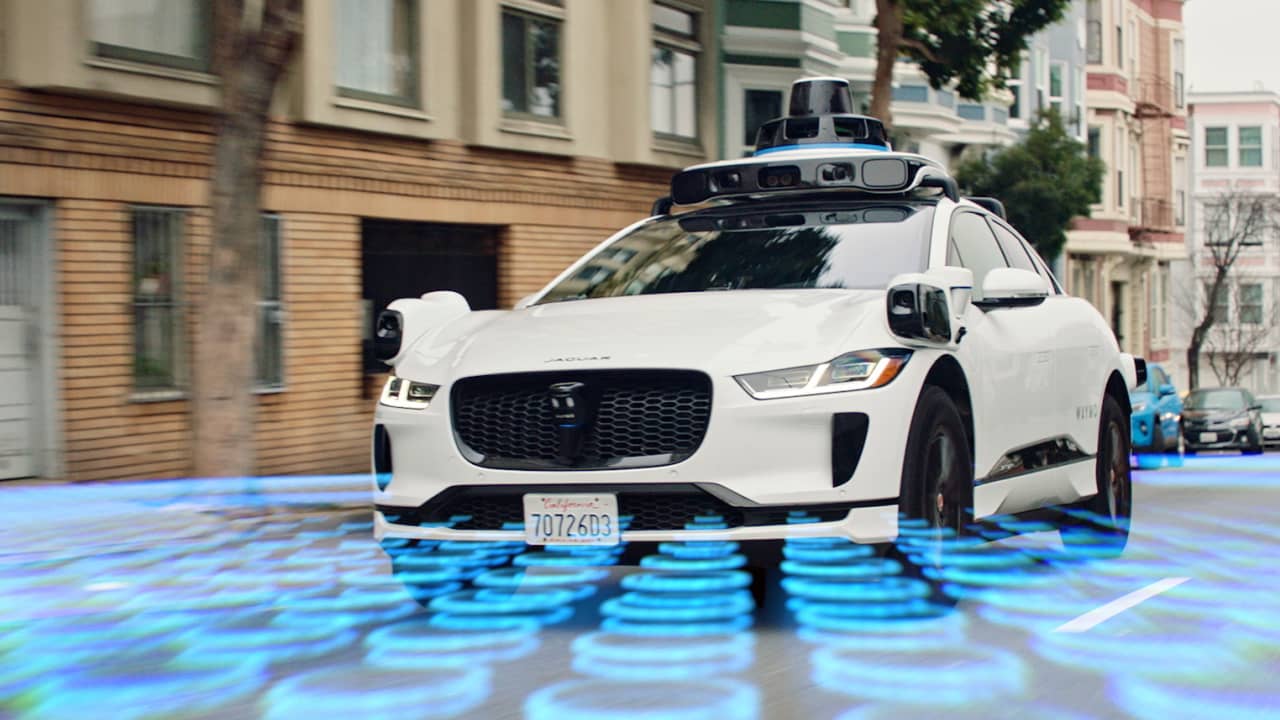
Source: Waymo USA
What is the current situation in the UK?
The current situation surrounding the regulation and operation of AVs in the UK is dynamic and rapidly changing based on ongoing consultations, testing and trials.
The Autonomous Vehicle Act
The UK's Automated Vehicles Act 2024 establishes a legal framework for self-driving vehicles, defining safety standards, clarifying liability by placing responsibility on corporations like manufacturers rather than individual drivers, and creating an in-use assurance system.
The Act allows for a gradual rollout, focusing initially on driverless services like automated taxis and goods transport rather than widespread private vehicle adoption. It aims to enable the safe deployment of autonomous technology, building on recommendations from the Law Commissions and setting safety principles that self-driving vehicles must meet to be authorised for use on UK roads. The act also allows for the protection of terms like "self-driving" to prevent misleading marketing of driver-assistance systems.
- The act requires self-driving vehicles to achieve a level of safety at least as high as careful and competent human drivers, as well as meeting rigorous safety checks before being allowed onto roads.
- The act delivers the most comprehensive legal framework of its kind worldwide, setting out who is liable for AVs meaning that drivers can be assured that, while their vehicle is in self-driving mode, they will not be held responsible for how the vehicle drives. For the first time, corporations such as insurance providers, software developers and automotive manufacturers can assume this responsibility.
Safety principles standard
The Department for Transport (DfT) and Centre for Connected and Autonomous Vehicles’ (CCAV) launched a consultation in June 2025 on the AV safety principles statement (consultation closed on 1 Sept). The call for evidence sought views on what the safety standards should be for AVs in the UK. Section 2 of the Automated Vehicles Act 2024 requires the Secretary of State for Transport to prepare a Statement of Safety Principles that apply to AVs.
This statement will be used in different ways across the safety framework, including:
- When authorisation authorities carry out vehicle type approval and authorisation checks (pre-deployment)
- When regulators carry out in-use monitoring and regulatory compliance checks (post-deployment)
- For annual assessments on the overall performance of automated vehicles
Living Streets fed in to the RoSPA consultation response which can be seen here.
Trials
In June 2025, the UK Government announced plans to fast track driverless vehicle trials in the UK.
AV technology
AV developers and operators like Waymo, Wayve, and Apollo Go use different technological approaches. Waymo and Apollo Go primarily use a model that combines cameras, lidar, radar and detailed mapping to enable autonomous operation, whereas Wayve is developing an AI-first approach that relies on large volumes of driving data to develop or ‘learn’ human-like driving skills and adapt to new roads without HD maps. Wayve’s approach arguably allows for greater adaptability to new driving environments without the detailed mapping on which other companies rely.
For Living Streets, the most important consideration is not the underlying technology itself but whether autonomous vehicles can safely operate in environments without jeopardizing pedestrian safety and comfort. Evidence on the performance of different approaches in these environments currently remains limited.
WHAT WE THINK
BENEFITS
Road Safety
The path to Vision Zero requires reducing severe crashes and improving the safety of those most at risk. The Institute for Engineering and Technology (IET) claims that for every 10,000 errors made by drivers, a self-driving vehicle will commit just one. This is supported by evidence showing that in 2020, 88% of all recorded collisions on roads in Great Britain involved human error as a contributory factor.
Research from studies in the US suggest that AV can reduce the number of severe collisions and impacts to the most vulnerable road user.
Impacts on accessibility
Some disability campaigners see the introduction of AVs as a potential opportunity to increase independence for disabled people.
Impacts on car ownership
The wider impact of AV operators on our streets and behaviour in the UK is not known. This is because we do not know what AV’s will be used for in the future – they may be used for individual ownership, freight, or public transport. However, in the long term if usage is well planned, and restricted to avoid AVs in private ownership, the market for individual car ownership may reduce. This could lead to freeing up kerbside space, as well as reduced congestion and air pollution, but this is yet to be proven.
Additionally, autonomous public transport is a potential approach to AVs that would combine autonomous vehicle technologies with public transport (for example, buses). This approach could reduce car ownership and improve the efficiency of public transport. An example of this approach is the introduction of autonomous shuttle buses in Barkarby, Stockholm, which used buses with lidar and mapping systems that followed a set route around a suburban area of Stockholm. However, there is little evidence on the benefits of this approach.
CONCERNS
Accountability and safety
The development of AVs raises critical ethical, moral and practical questions around how AVs are programmed to behave when exposed to pedestrians on the street, and who or what is responsible for road behaviour when crashes take place. The Autonomous Vehicle Act 2024 goes someway to setting out the liability framework for AV technology, which we welcome.
It is critical that AV operators can demonstrate that their cars can mix safely with all road users in each location before being allowed onto streets used by people walking and wheeling. Human error is predictable (this is the premise of Vision Zero). It can only be reduced when/where humans are removed from the equation. Interaction of AVs with vehicles, pedestrians, cyclists etc that are not AV will continue to be unpredictable. For this reason, AVs should only be permitted when a high degree of safety can be guaranteed, without relying on human intervention at critical moments. AVs could be limited to specific infrastructures (e.g. guided busways) and speeds until safe operation can be guaranteed.
Indeed, there are numerous examples of AVs making mistakes and putting pedestrians and other road users at risk:
- Waymo vehicle hits school child in California
- China halts all licenses for AVs after Apollo Go outage in Wuhan caused vehicles to stop in the street.
- Waymo vehicles pass stopped school busses in Texas which had stop signs and red light flashes going.
- Waymo recalls nearly 4000 vehicles after its vehicles entered closed-off highway construction zones in multiple US cities
Accessibility
Claims that AVs will improve accessibility, including for disabled people, may not be reliable, with disability access campaigners raising concerns that “we need to remember these companies are ultimately answering to the interests of investors”. AV technology has been seen to fail to drive safely around disabled pedestrians, and anyone who appears or moves in ways the vehicle's training doesn’t expect can be put at greater risk. People who need assistance to use taxis also risk being excluded from essential access if taxis without drivers become the norm.
However, some groups representing disabled people such as RNIB, see the introduction of AVs as an opportunity for disabled people to travel more independently.
The introduction of AVs should not be at the cost of accessibility and robust testing and safety procedures in place to limit exclusion.
Pedestrian priority
We are living with streets that have been designed around the car – for the last 80 years priority has been given to the motor vehicle and traffic flow. This needs to change.
Recent research, which analysed the composition of more than 86 million total vehicle miles travelled over 14 million Waymo robotaxi trips, found that only 54% of all miles travelled by Waymo in California were driven with a passenger on board. This suggests that the introduction of autonomous vehicles may add to the current system that prioritises motor vehicles over people. If AVs are introduced in the UK, there needs to be a process in place for when AVs are not booked, to avoid adding unnecessary congestion to our streets.
Technology should not be introduced at the expense of pedestrian or cyclist freedom to use roads and pavements safely and conveniently. If AVs are to be successfully introduced, they must adhere to the Hierarchy of Road Users, the Highway Code (including pedestrian priority at side roads) and should be part of the solution to re-design our streets to put the most vulnerable at the heart of change.