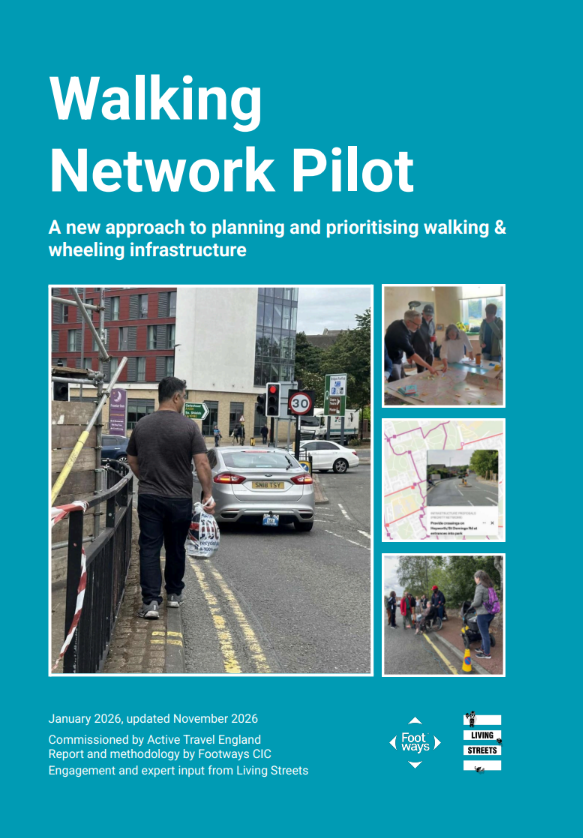
Walking Network Pilot
Walking is the most universal form of transport. It underpins almost all local journeys, connects people to public transport, and is fundamental to health, access, inclusion and the quality of places.
Despite this, walking has often been under-prioritised in transport planning and investment. Within many Local Cycling and Walking Infrastructure Plans (LCWIPs), walking network planning is typically less developed, less detailed and less clearly prioritised than cycling, making it harder for local authorities to identify schemes, secure funding and deliver change.
The Walking Network Pilot was commissioned by Active Travel England to address this gap. Working with local authorities in five locations – Bristol, Liverpool, Maidstone, Sheffield and Sunderland – the pilot developed and tested a practical methodology for identifying what an attractive, functional and accessible walking network might look like, and for translating this into clear, prioritised proposals that can inform future investment.
Two main conclusions emerge from the pilot. First, walking needs its own network, with its own hierarchy of routes, so that councils can see where investment will make the greatest difference. Second, that network cannot be identified from data or desktop research alone.
The full report is coming soon. For now, read the executive summary.