
Delivery Robots
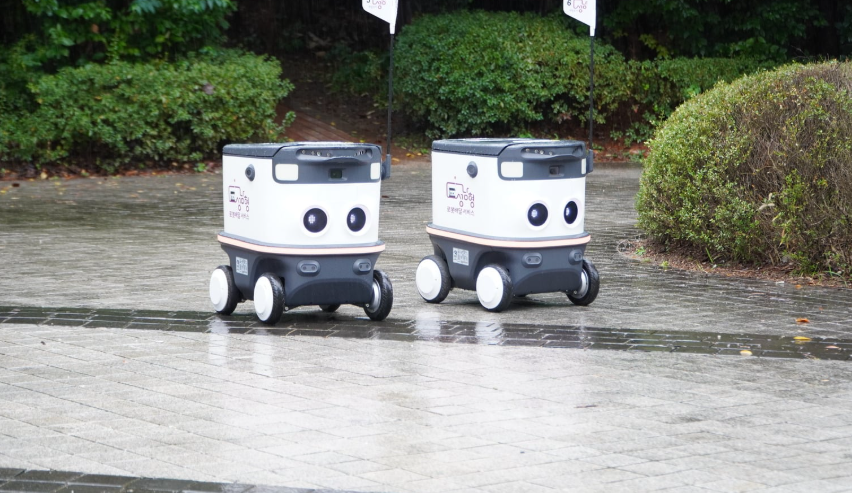
Delivery robots are small, autonomous vehicles designed to transport parcels using cameras, sensors and GPS to navigate the streets.
These vehicles primarily operate on pedestrian infrastructure such as pavements and pedestrian crossings rather than on the carriageway.
In the UK, delivery robots usually operate up to 4mph on pavements – the same speed as powered mobility devices.
The vehicles usually consist of small box-shaped wheeled robots that operate autonomously. Delivery robots are generally used for last-mile deliveries of groceries, take-aways, and parcels. In the UK, the rollout of delivery robots has primarily been for food and takeaway delivery services.
Where do delivery robots operate?
Between 2018 and 2026, delivery robots have rapidly expanded from a small number of pilot schemes to operating in more than 80 cities across North America, Europe, and Asia. Since starting operations, Starship Technologies, the biggest global delivery robot operator, have made over ten million deliveries globally.
While they are often associated with the United States – where deployment has become widespread – delivery robots have also been quietly operating in the UK since 2018.
In the UK robots are currently operating, or have been previously deployed, in a growing number of towns and cities, including Milton Keynes, Barnsley, Sunderland, Sheffield, Reading, Bristol, Leeds, and Cambridge.
Some key examples in the UK include:
- Milton Keynes, where robots have become a common feature of the city. Since 2018, companies such as Just Eat, Uber Eats, DPD, Co-op, and Amazon have trialled or operated services there – including throughout the Covid-19 pandemic.
- Leeds, where the co-op has operated delivery robots in partnership with Starship Technologies since 2022, with recent expansion of Uber Eats in additional areas.
- Sunderland, where Just Eat and Starship Technologies have partnered to delivery services.
- Barnsley, where Just Eat and Starship Technologies have been operating, alongside a trial of Evri delivery robots.
Regulation of delivery robots
At present, there is no dedicated national framework governing the use of delivery robots in the UK. Instead, their operation is generally covered by existing national and local regulations addressing their conduct on the roads and pavements. This has led to a regulatory environment where there has been a lack of due diligence before the rollout of technologies like delivery robots on our pavements - including engagement with local councils and communities - especially compared to the due diligence that would be necessary if these vehicles were on the roads.
UK regulations
In particular, UK roads and pavements are governed by the Highways Act 1980. However, many stakeholders argue that this legislation is not well suited to emerging technologies such as delivery robots. The Act prohibits “carriages” from operating on pavements, but the definition of a carriage has not been updated to explicitly include – or exclude – autonomous delivery devices. As a result, the legal status of delivery robots remains unclear. In practice, this has led to trials proceeding either with the permission of local authorities or councils or, in some cases, without permission. The problem with outdated legislation extends beyond delivery robots and applies to other new technologies such as micro-mobility devices (e-scooters and e-bikes), and modern powered mobility devices which have implications for the accessibility of our pavements.
Since the launch of our 'Pavement Overload' campaign, The UK Government has committed to introduce a new Low-speed Zero Emission Vehicle category to regulate micromobility vehicles, including pavement robots, when parliamentary time allows.
Beyond The UK
This regulatory ambiguity is not unique to the UK. Approaches to regulation vary considerably both between and within countries. These range from complete bans – such as in parts of Chicago – to approaches permitting robots subject to restrictions on size, weight and speed, or limit their use to pilot schemes, as seen in cities including San Francisco and Vancouver. Other jurisdictions have adopted more permissive models, for example, states such as Pennsylvania have classified delivery robots as pedestrians, effectively granting them the same rights to use pavements as human users. Similarly, Japan has amended its Road Traffic Act to allow certain categories of remote-controlled delivery devices to operate on public streets.
What do proponents say?
Proponents of delivery robots – including Starship Technologies and companies like Uber, Just Eat, and Amazon who are piloting the technology – argue that they reduce the carbon emissions associated with last-mile deliveries by displacing car and van trips, while helping businesses respond to the rising demand for home deliveries. Additionally, they argue that they are faster and provide more accurate delivery times. Companies often frame the technology as a complement to human couriers rather than a replacement and talk of a future in which robots and workers operate side by side.
Concerns
Delivery robots raise significant concerns for pedestrians. By occupying pavement space, they add congestion and clutter to the pavements, increasing competition for pavement space that is already a major issue in the UK – for example micromobility modes, electric vehicle charging points and pavement parking. This disproportionately affects disabled people (particularly wheelchair users and visually impaired people), older pedestrians and adults with prams and pushchairs. There are also unresolved questions about liability when incidents occur, as well as privacy concerns linked to the use of cameras in public space.
More broadly, the private-led rollout of delivery robots using public space for private profit presents a risk of alienating communities if technologies are tested and deployed without democratic oversight or public engagement. The expansion of delivery robots arguably represents a shift in whose needs are prioritised on our pavements.
Indeed, the rollout of delivery robots around the world has prompted mixed responses from communities. There has also been some tangible negative impacts of the devices, including:
- Food Delivery robots being banned from the university of Pittsburgh due to accessibility concerns – a student was blocked from the only dropped kerb on the pavement.
- Delivery robots were banned in Toronto in 2021 due to concerns around accessibility for disabled people.
- Delivery robots were banned in a large part of Chicago after residents led a campaign citing that the robots clogged the pavements and injured people.
- A delivery robot crashed into a man with cerebral palsy on his mobility scooter in Los Angeles.
- A delivery robot crashed into a dog in Bristol.
What do we think?
Living Streets does not want to see delivery robots on our pavements.
We believe that pavements are for people, and the operation of robots puts the safety of pedestrians at risk - particularly for those with mobility issues. We want to make streets and pavements accessible to all – so everyone can walk and wheel their short, everyday journeys to their local shops, cafes and restaurants.
We think that claims that delivery robots represent progress for sustainability are overstated. While framed as efficient and low-carbon, their operation on pavements places private commercial convenience in competition with pedestrian safety and comfort. Without a clear national framework, robust safeguards for pedestrian space, and genuine public consent, delivery robots risk contributing streets that put vehicles over people.
We want the UK Government to exclude autonomous delivery robots from upcoming plans around micromobility regulation - and these policies to outlaw Low-speed Low Emission Vehicles from operating on pavements.