
“I’m here. Don’t forget that I still exist”: Nush Luther-Smith on access, safety and being seen
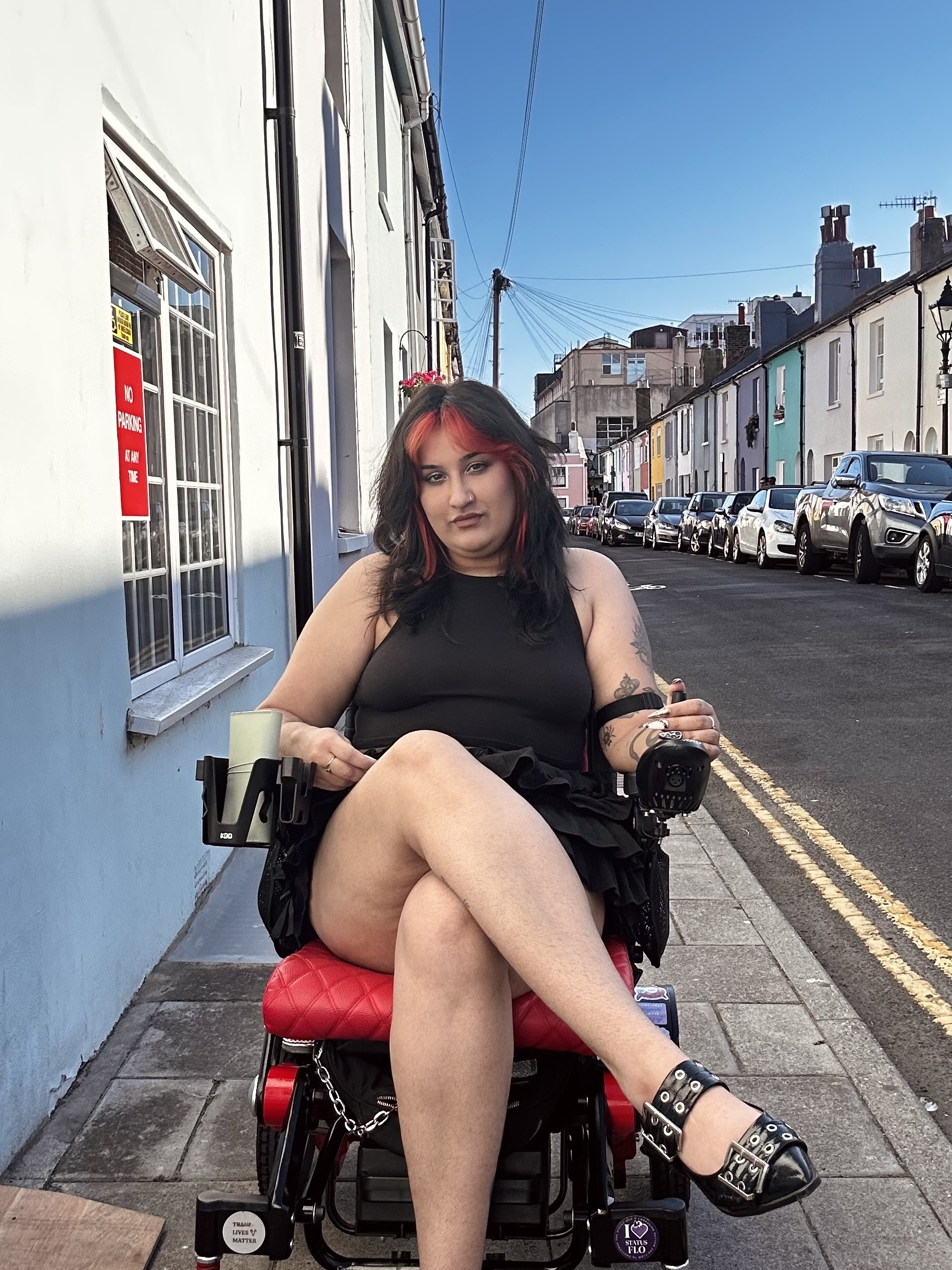
For Brighton-based artist, activist and content creator Nush Luther-Smith (she/they), navigating the world as a wheelchair user has revealed just how many barriers disabled people face every day, and how those barriers can affect both freedom and safety.
Nush, who features in Living Streets’ campaign film Making Streets Safer for Women and Girls, has become a powerful voice for accessible streets, highlighting the everyday obstacles that can make leaving home a challenge. Nush’s journey into disability activism grew from both her professional background and own lived experience.
Nush studied sociology and social work, specialising in supporting disabled children and their families. Through that work, she began to understand that what disables people isn’t their condition itself, but the barriers created by the world around them. When chronic illness later led Nush to begin using mobility aids and, eventually, a wheelchair, those realities became personal.
The barriers that stop people leaving home
For Nush, inaccessible pavements remain one of the biggest issues.
Poorly maintained or missing dropped kerbs can make routes impossible to navigate, while pavement parking creates additional barriers. On more than one occasion, vehicles parked across the pavement have prevented her from leaving altogether.
“I've missed a hospital appointment, and I've missed a GP appointment because I literally couldn't get out of my own home.”
But physical barriers are only part of the story.
Nush says the attitudes she encounters can be just as challenging. Asking drivers to move vehicles can result in confrontation, while travelling through public spaces often means dealing with comments, scrutiny or harassment.
“I know a lot of disabled people who just avoid going outside because they don't want to have to navigate people more than the pavements, it’s the people.”
When disability and gender intersect
As a woman travelling alone, Nush says safety concerns shape many journeys.
Nush carefully plans routes, avoids areas where groups of drunk people often gather and considers factors that many non-disabled people never have to think about. When pavements are blocked, detours can mean travelling along unfamiliar or less well-lit routes.
“You want to get home as quickly and most straightforward as possible,” she says. “When you have to start taking detours, especially if you're in an area that you're unfamiliar with, you can get quite stuck and that can be really quite scary.”
The challenges can become even greater when travelling with other wheelchair users. Most buses only have one wheelchair space, meaning friends are often forced to travel separately.
“If you're travelling somewhere late at night and you're having to basically go and sit at a bus stop waiting for your friend to arrive on the next bus, that can make you quite vulnerable if you're just sitting at a bus stop alone."
“Every time you go out, you don't have a choice but to have to figure it out. People have been dealing with this for a really long time. I'm angry for them.”
The hidden impact of inaccessible streets
One of the strongest messages Nush wants policymakers to understand is that access is not simply a transport or infrastructure issue.
“Access impacts mental health,” she says.
What may appear to be a small obstacle, such as a blocked dropped kerb, an advertising board or outdoor seating, can have far-reaching consequences when combined with other barriers throughout a journey.
Reflecting on their own experience of being largely housebound, Nush describes how exclusion from public spaces can affect every part of a person's life.
“When you actually live that experience constantly and you have the choice of either staying inside or challenging yourself in order to get outside, it can make you feel like the world isn't built with you in mind.”
Nush argues that disabled people are too often told to avoid places that are inaccessible rather than seeing those barriers removed.
“Someone's life shouldn't be confined to one room.”
Why disabled voices must be heard
Nush is also concerned about the growth of pavement-based technologies such as delivery robots.
While often presented as innovative solutions, she believes their impact on disabled pedestrians is frequently overlooked.
“I think you'd need to speak to a variety of people with different intersections and different lived experiences,” she says, arguing that meaningful consultation with disabled people must happen before new technologies are introduced into public spaces.
“Experiences will differ between wheelchair users, blind and partially sighted people, people using walkers and many others”, she says, making lived experience essential to understanding the real-world impact.
For Nush, the solution starts with listening.
“There’s a lot of under-representation for disabled voices. I see it as a lack of provisions issue.”
Nush’s message is a reminder that safer, more accessible streets benefit everyone. When pavements are designed with disabled people in mind from the outset, they create communities where more people can participate, travel independently and feel safe doing so.
As Nush puts it: “I'm here. Don't forget that I still exist."
About the author
Living Streets