
Elections 2026 - one week on

A week on from elections across the UK, and the dust starts to settle, Head of Campaigns & Public Affairs Ruth Billingham takes a look at the new political landscape and what it means for walking and wheeling.
Scotland
The Scottish National Party (SNP) will retain a minority government in the Scottish Parliament.
What did the SNP say about Active Travel in their manifesto?
- “We will work with the Scottish Outdoor Recreation Alliance and others to develop a Scottish Paths Fund, and produce new guidance for access authorities on how to fulfil their responsibilities”.
- Formal request that Ordinance Survey mark Scotland’s core paths on their maps.
- £2.5m bike repair scheme to enable 33,000+ people to get support with repair costs.
- Commitment to a “Better Surfaces” fund to support local government capital expenditure in fixing potholes, resurfacing and improving drainage from roads.
The Manifesto is light on investment into active travel, with little ambition for change. The Manifesto includes plans on Net Zero and moves towards more affordable public transport.
Next steps in Scotland
Our joint manifesto with Walking Scotland included key calls:
- Put walking and wheeling at the heart of government
- Invest in walking and wheeling
- Prioritise walking and wheeling in communities
- Improve safety for walking and wheeling
Following the appointment of the new Scottish Government later in May we will work with new Ministers to call for these to put into action. Scotland is now the only nation which hasn’t permitted the use of side road zebras so this is likely to be a key focus. Many candidates replied to our Manifesto calls and we will map these and follow up with those now elected.


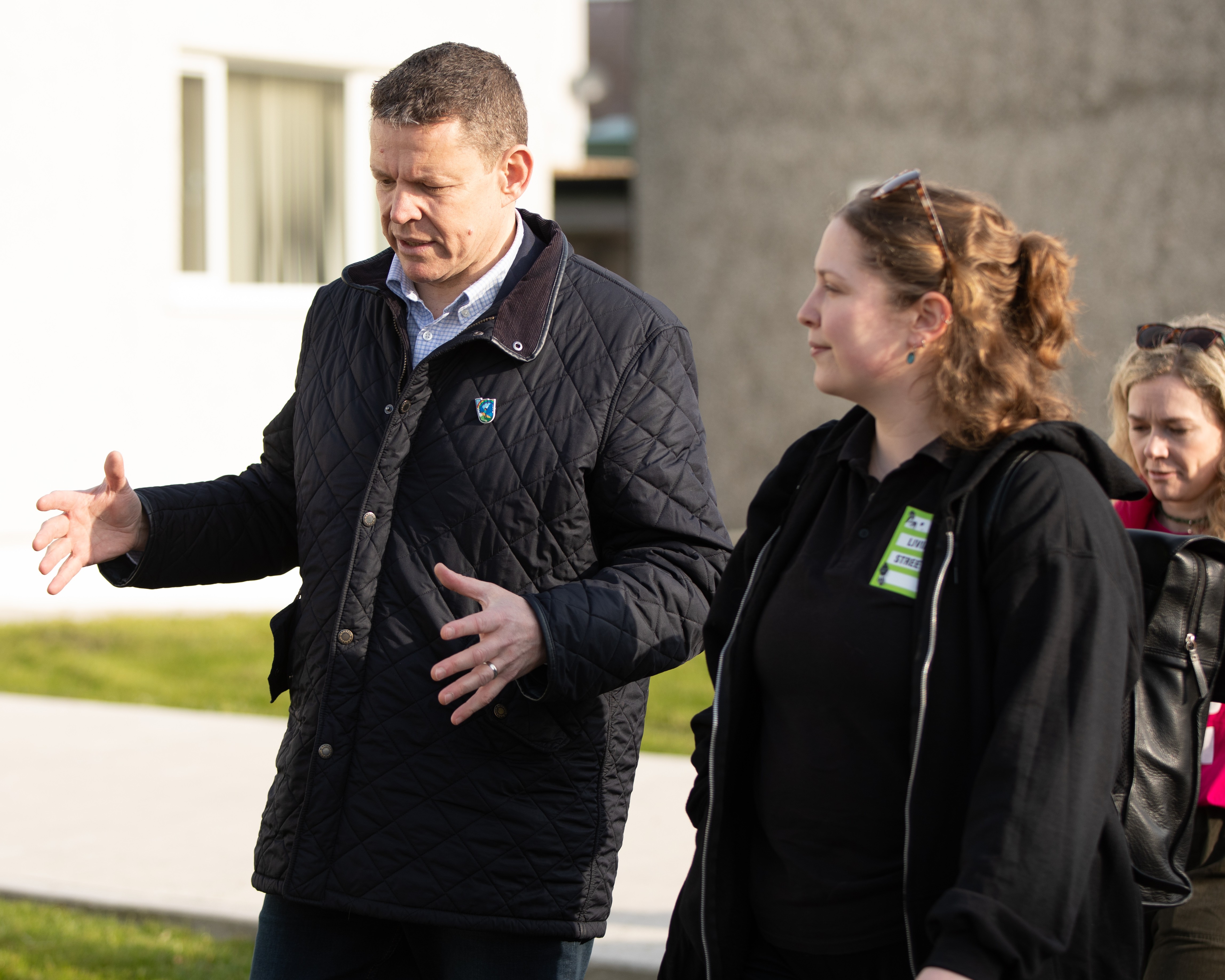
Rhun ap Iorwerth joined pupils of Ysgol Gymuned Y Fali and Living Streets Cymru to celebrate the Walk to School in March
Wales
For the first time in its 27-year history the Senedd is now not led by Welsh Labour. Plaid Cymru will be running a minority government and will need support from other parties to pass legislation. And Reform UK is now the biggest opposition party.
What did Plaid say about Active Travel in their manifesto?
“A Plaid Cymru government will put active travel at the heart of Wales’s transport system, promoting good health and ensuring safe, accessible routes for people to walk, wheel, and cycle. We will:
- Ensure public investment in active travel is strategic and effective, measuring success by behavioural change and the quality of networks, not simply levels of expenditure.
- Provide clear statutory guidance to local authorities, setting out priorities, expectations, and outcomes for active travel.
- Embed active travel across bus, road, and rail planning and delivery.
- Support increased investment in bike-hire schemes in towns and cities across Wales.”
The Manifesto also focuses on developing a more integrated public transport system to include walking, wheeling and cycling, which is to be welcomed. The First Minister has previously spoken out in favour of retaining the 20mph speed limit in residential areas.
Next steps in Wales
Our Manifesto in Wales included five key calls:
- Get cars off pavements
- Fix our pavements
- Make sure children are safe walking to school
- Tackle inconsiderate drivers and riders
- Improve our high streets
Over the next few months we will call on the new Welsh Government to take action on pavement parking – the opportunity is now given we have a new Welsh Government and against the backdrop of significant progress in England. We will look to build relationships with new Ministers in the Senedd and developing our network of Walking Advocates. Many candidates replied to our Manifesto calls and we look forward to working with them to enact positive change to our streets.
England
In England, 5,066 councillors across 136 local authorities (All 32 London borough councils, 32 metropolitan boroughs, 18 unitary authorities, 6 county councils, 48 district councils) and 6 directly elected mayors were elected on 7 May.
A significant outcome was the emergence of a ‘five-party split’ in the vote, had all Great Britain of gone to the polls last Thursday.
An outcome of this are many historical Labour-held councils being lost (to generally Reform UK in ‘Labour heartland’ areas and the Green Party in metropolitan centres) or returning a no party majority – probably most notably in Birmingham, where the City Council has no overall control and five parties have at least a dozen councillors each. The Liberal Democrats gained many new councillors, defended most of their existing held councils; with the Conservatives losing control of seven councils.
What about London?
The ‘five-party split’ and rise of council returning no party majority held true in London.
The Greens won mayoral and council elections in Hackney and Lewisham and took control of Waltham Forest Council; Reform UK took Havering, the Conservatives took Westminster, Aspire won in Tower Hamlets and the Liberal Democrats held their three controlled London Councils.
But what does all this mean for walking & wheeling in England?
Ahead of the election, Living Streets encouraged our supporters and Local Groups to call on Councillor and Mayoral candidates to make use of new powers available to create safer streets devolved to them from the UK Government.
In England (excluding London), this means pavement parking – with local leaders across England now empowered to prohibit footway and verge parking, where civil enforcement power applies*.
With the ‘five-party split’, as well as many councils having no party majority, we are concerned that the bold leadership required to address transport issues, such as pavement parking, may struggle to secure the changes required.
Despite the popularity of a pavement parking ban, as shown from a recent YouGov poll, a devolved approach to transport issues like pavement parking, could lead to inconsistent application of new powers awarded via English Devolution.
Many local authorities have expressed concerns over prohibitions of pavement parking, and with Council majorities now rarer following these elections, with Mayoral Combined Authorities rely on consensus from local councils to operate – we hold concerns that pavement parking could be absorbed as a ‘culture war’ political issue. We expressed these concerns following the UK Government’s response, outlining a devolved approach to pavement parking, to the DfT’s 2020 consultation on pavement parking in January.
In Westminster specifically, the now Conservative-controlled Council has immediately raised a legal challenge against the pedestrianisation of Oxford Street. However, as the street is under control of the Mayor of London, we hope this challenge will be unsuccessful.
We’ll also be working with our Local Group Network to nurture new relationships between Living Streets, local ward councillors and Highways Cabinet Member/Committee Chair’s.
*We await the UK Government to pass secondary legislation which will enable civil enforcement officers to enforce against ‘unnecessary obstruction of the footway’.

Over the coming months, we'll be making our voices heard - developing relationships with key players in the new Scottish & Welsh Governments'. We'll also be equipping our Local Groups and supporters with tools to influence their newly-elected national and local elected representatives across Great Britain.
We wouldn't be able to do this work, fighting for a future which puts pedestrians first without our members. Find out more about membership and other ways you can support Living Streets via the button below.

About the author
Ruth Billingham
Head of Campaigns and Public Affairs, Living Streets
[email protected]